If you came looking for animatediff and are comparing AI video tools, this review shows how Higgsfield plan credits relate to observed video usage. It also explains why a per-clip dollar figure does not establish equivalent output.
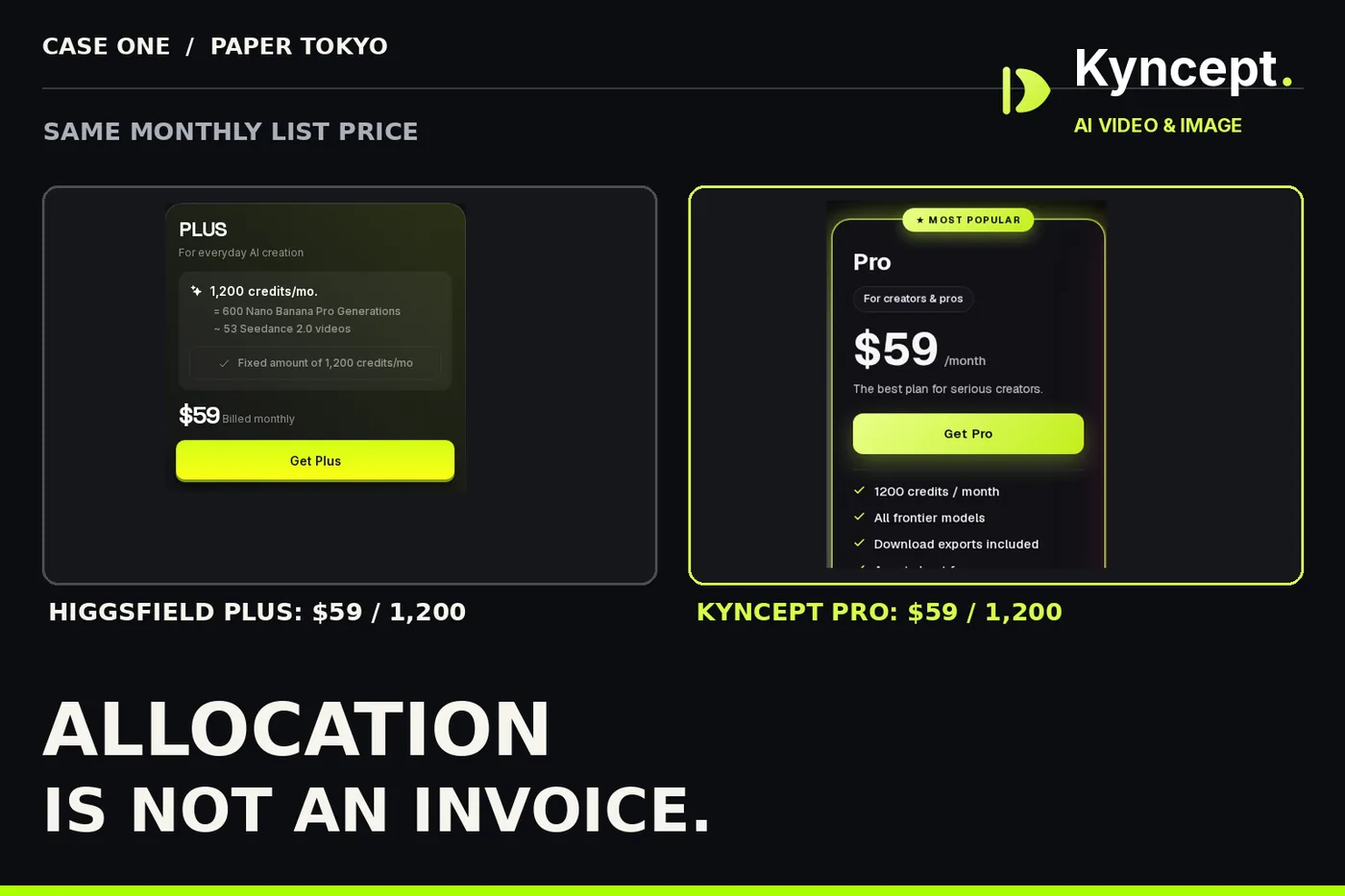
Two public $59 monthly plans each list 1,200 credits. That symmetry does not make their credits fungible, their Tokyo videos equivalent, or the arithmetic below an actual per-clip invoice.
Independent review: both products were run on my own accounts — a free tier and a paid plan — with no vendor-provided access.
My verdict in 60 seconds
The October 1, 2026 public snapshot shows Higgsfield Plus at $59 billed monthly for 1,200 Higgsfield credits and Kyncept Pro at $59 per month for 1,200 Kyncept credits. This test consumed nine of the former for one 5.042-second Higgsfield video and ten of the latter for each 8.000-second Kyncept video. If—and only if—a subscriber fully uses the credit bundle at its stated monthly price, simple allocation assigns $0.4425 to the observed Higgsfield task and about $0.4917 to a Kyncept task. Neither number is cash charged for this trial, a transaction price promised at checkout, or the cost of the same length and quality of video.
- Monthly price basis — Plus $59/1,200 and Pro $59/1,200, separately stated in each product's own units.
- Observed video debit — Higgsfield nine credits, Kyncept ten credits per completed job.
- Video delivered — Higgsfield 5.042 seconds at 1904×1104; Kyncept 8.000 seconds at 1280×720.
- Observed image debit — Higgsfield two credits per Nano Banana Pro image; Kyncept one credit per Nano Banana Pro image.
- Critical omission in any one-number “winner” — the Kyncept video set contains three visually near-repeat outputs, while Higgsfield has only one Tokyo video for this case.
The case's raw ledger and price-provenance record separate observed usage from hypothetical dollar allocation.
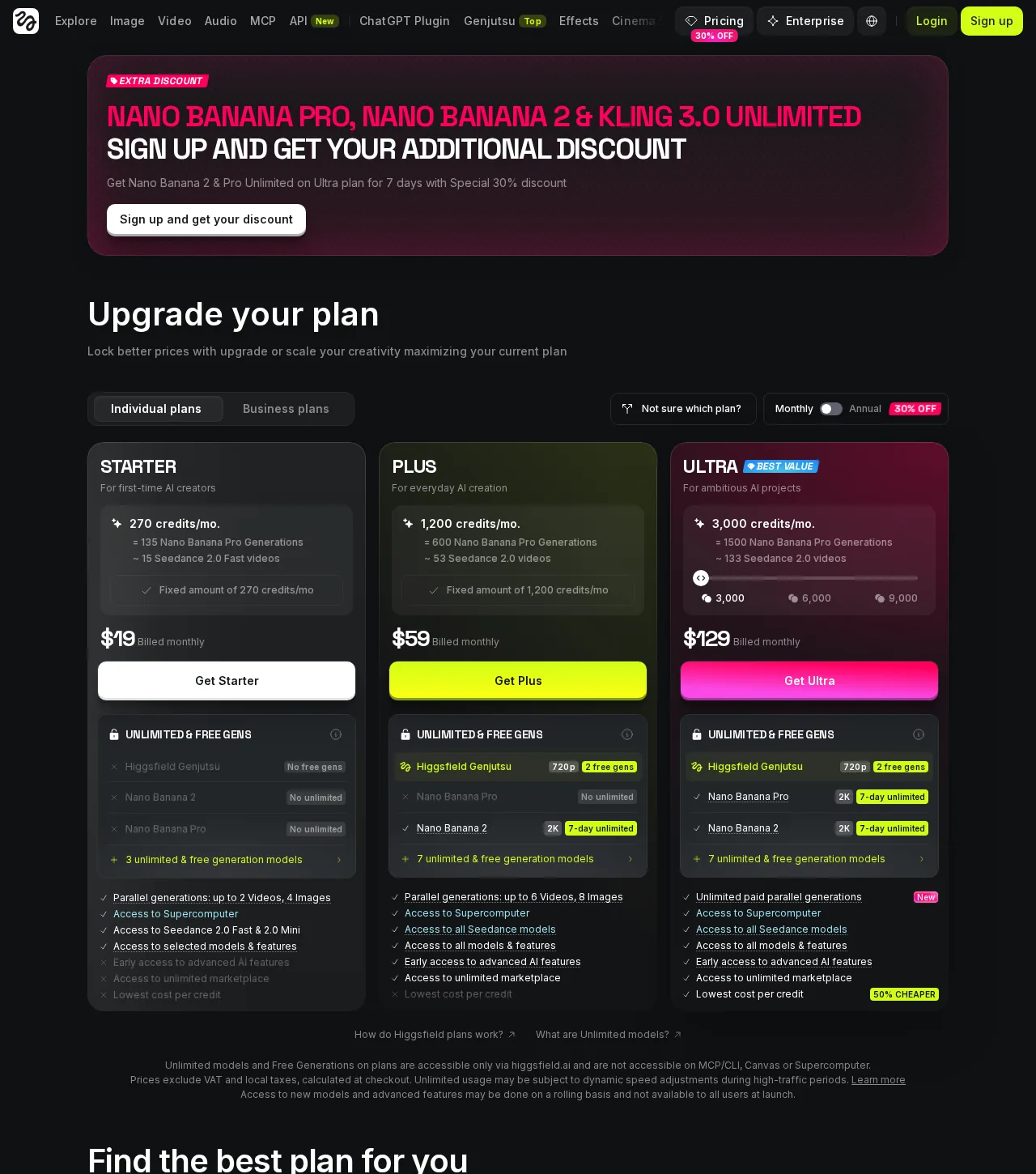
Anonymous public Higgsfield pricing page with its Monthly switch selected; Plus displays $59 billed monthly and 1,200 credits per month.
The limit of this comparison
Kyncept's public pricing and Higgsfield's public pricing were checked in an anonymous browser, and both price screenshots were inspected before archiving. This is not financial or product advice. No purchase, card entry, fresh registration or checkout confirmation was made. The exact price a particular customer pays after taxes, geography, discounts or account-specific entitlements was not established.
The actual test ran on existing credit balances. No dollar amount was deducted per generation in the visible record. Assigning a share of a monthly subscription to one task is a modeling choice, not a reconstructed bank statement. That distinction is the premise of the article rather than fine print at the end.
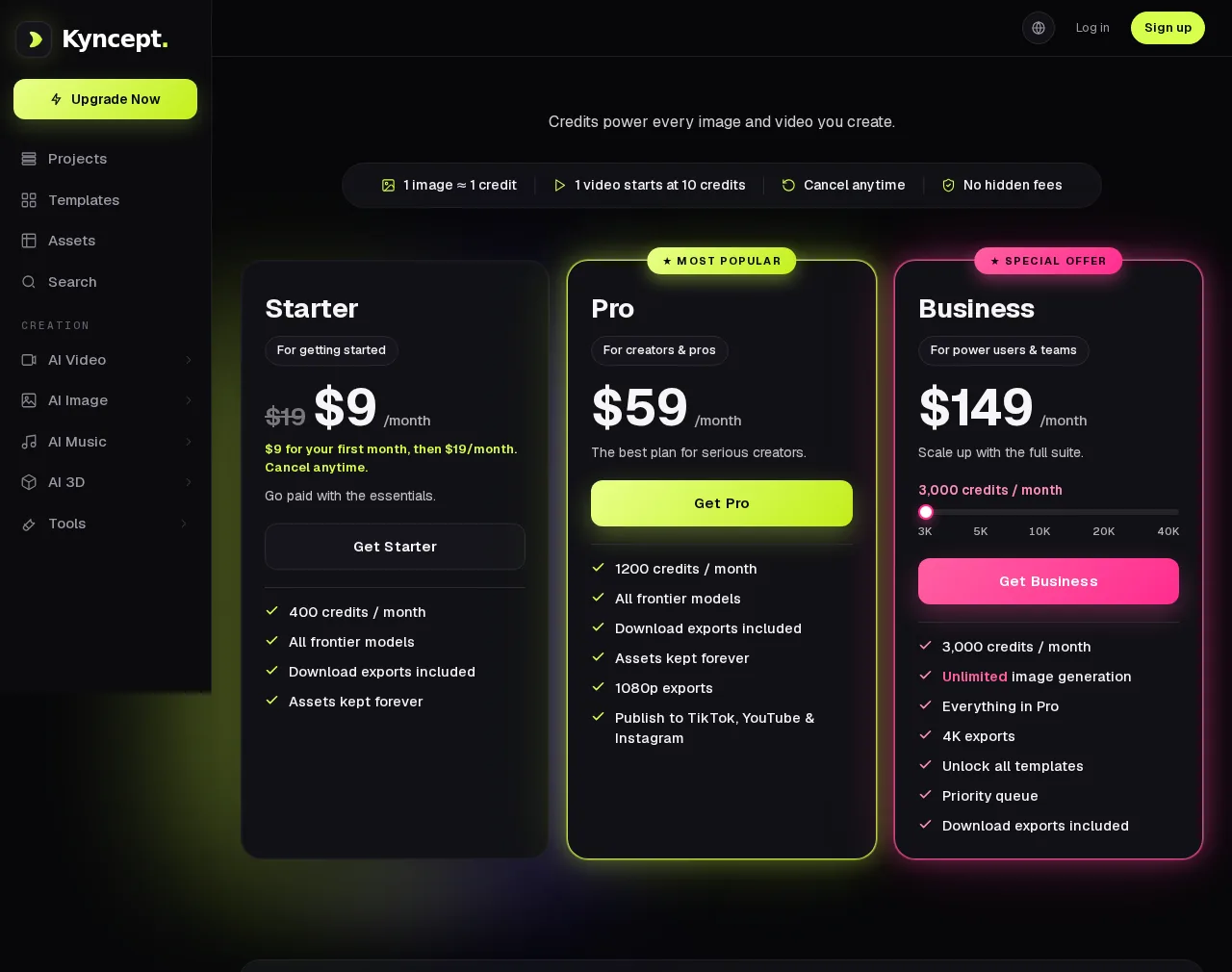
Kyncept's anonymous public pricing page: Pro $59 per month and 1,200 Kyncept credits per month. Its Starter first-month offer is separate from the recurring price.
The price snapshot, not an old rate card
The Higgsfield monthly card showed Starter $19/270 credits, Plus $59/1,200, and Ultra $129/3,000. The comparison uses Plus, not Starter: the Starter copy describes access to selected models and the case did not verify whether Wan 2.5 Fast belongs to that tier. The page also displayed an annual Plus figure of $47 per month billed annually; this article does not pair an annual commitment with Kyncept's monthly price.
Kyncept's public card showed Starter $9 for its first month, then $19/month, with 400 credits/month. Pro displayed $59/1,200; Business displayed $149/3,000 at the visible slider position. Neither a temporary introductory month nor a larger-business feature list belongs in a like-for-like monthly Pro/Plus calculation. These are a dated, anonymous public-page observation, not a guarantee that the same figures remain on a future publication day.
A page showing “all models” is also not a completed checkout or a test of every model entitlement. The Plus and Pro plan copy supports the broad comparison of listed bundles; the actual Tokyo balances support the separate record of usage. Both facts are needed, and neither should be silently substituted for the other.
What the Tokyo jobs actually consumed
The successful Higgsfield Wan 2.5 Fast job took the video account from 10 to 1: nine Higgsfield credits, one resulting MP4. Its UI selected five seconds and 720p, and the downloaded file measured 5.042 seconds and 1904×1104. The submitted text requested eight seconds, but the menu did not. A neighboring “Failed / Credits refunded” badge belonged to another task and was not the status of this Tokyo job.
The three successful Kyncept Plus jobs moved the balance 343→333→323→313. That is ten Kyncept credits per job and three 8.000-second, 1280×720 MP4s. The three look unusually similar in this case, which changes what “three outputs” might be worth to someone seeking three creative alternatives. It does not change the arithmetic of the visible deductions.
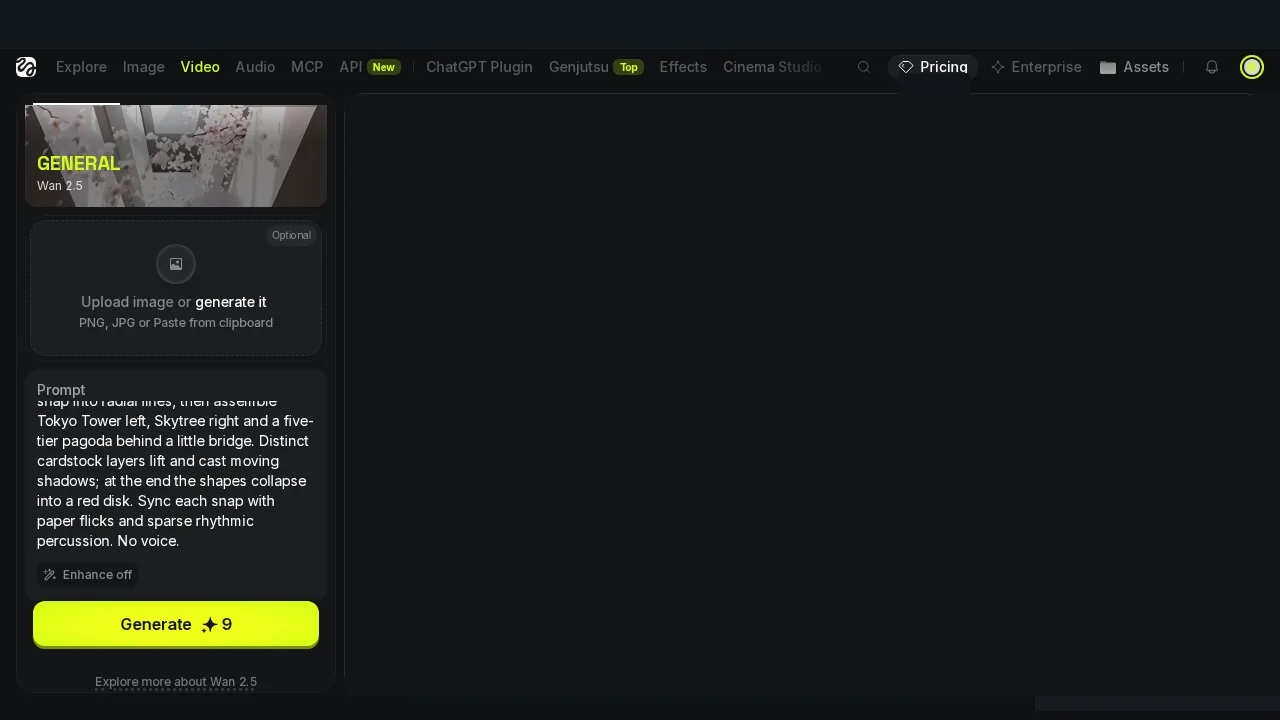
The Higgsfield interface choice was five seconds and 720p. The resulting source file has its own measured pixel dimensions.
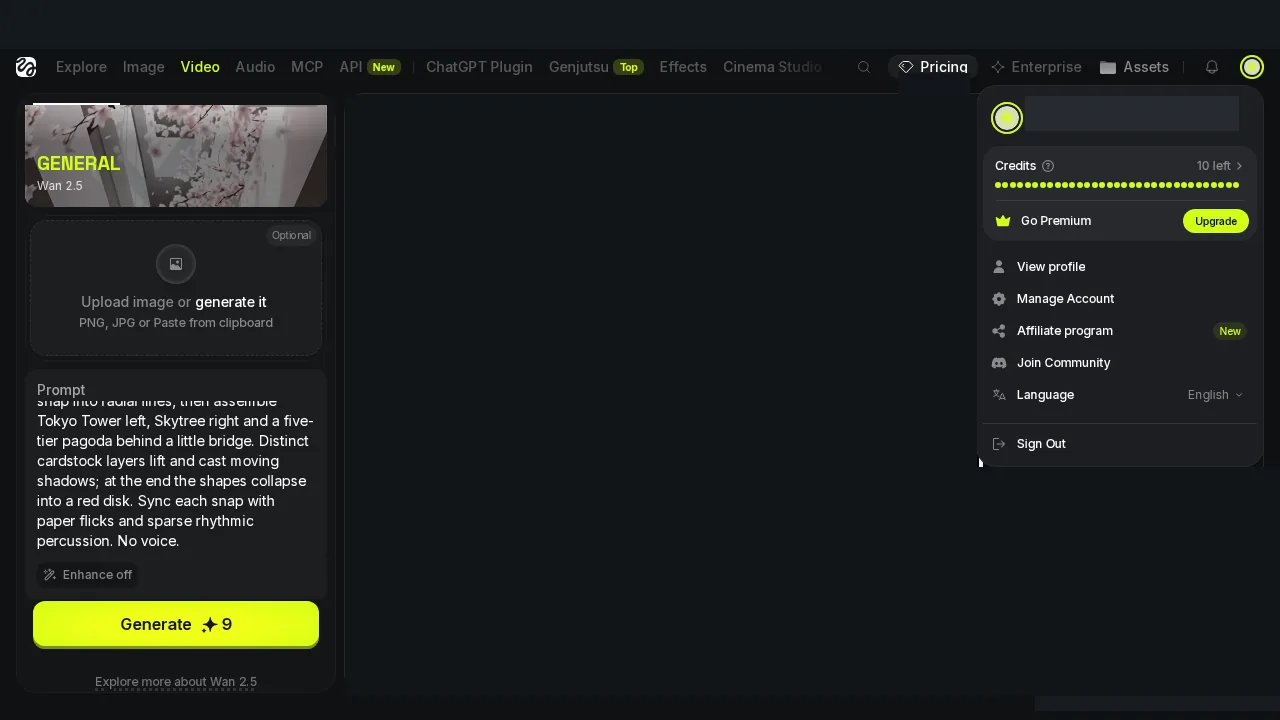
The anonymous pre-run wallet shows ten Higgsfield credits and a nine-credit Generate action.
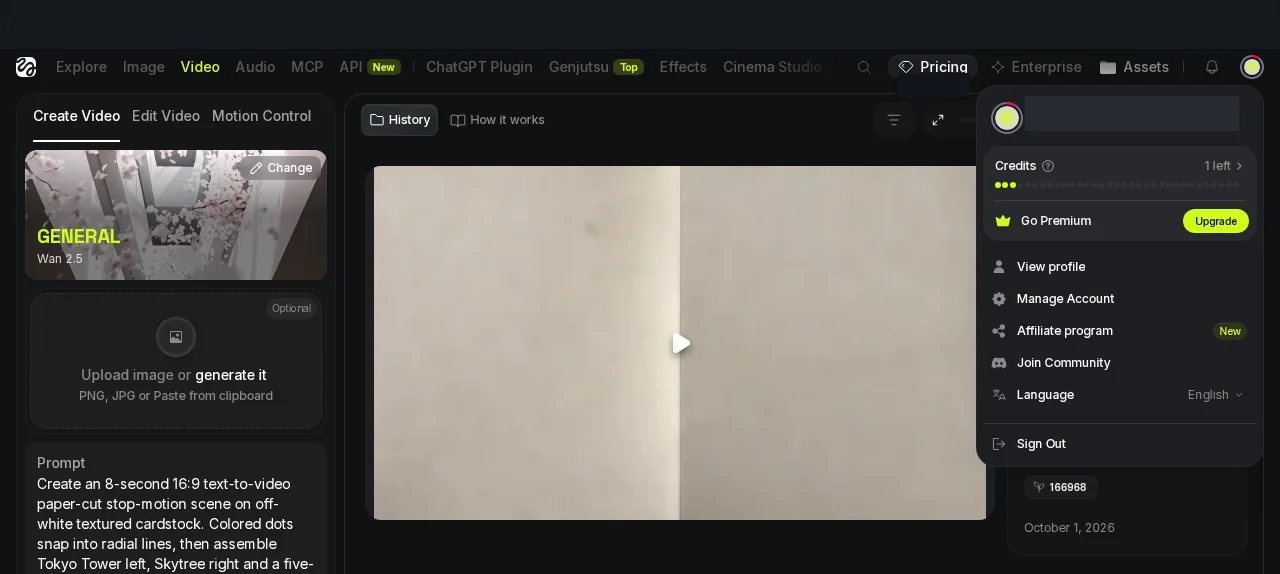
The visible Higgsfield balance is one after the Tokyo completion, versus ten before it.
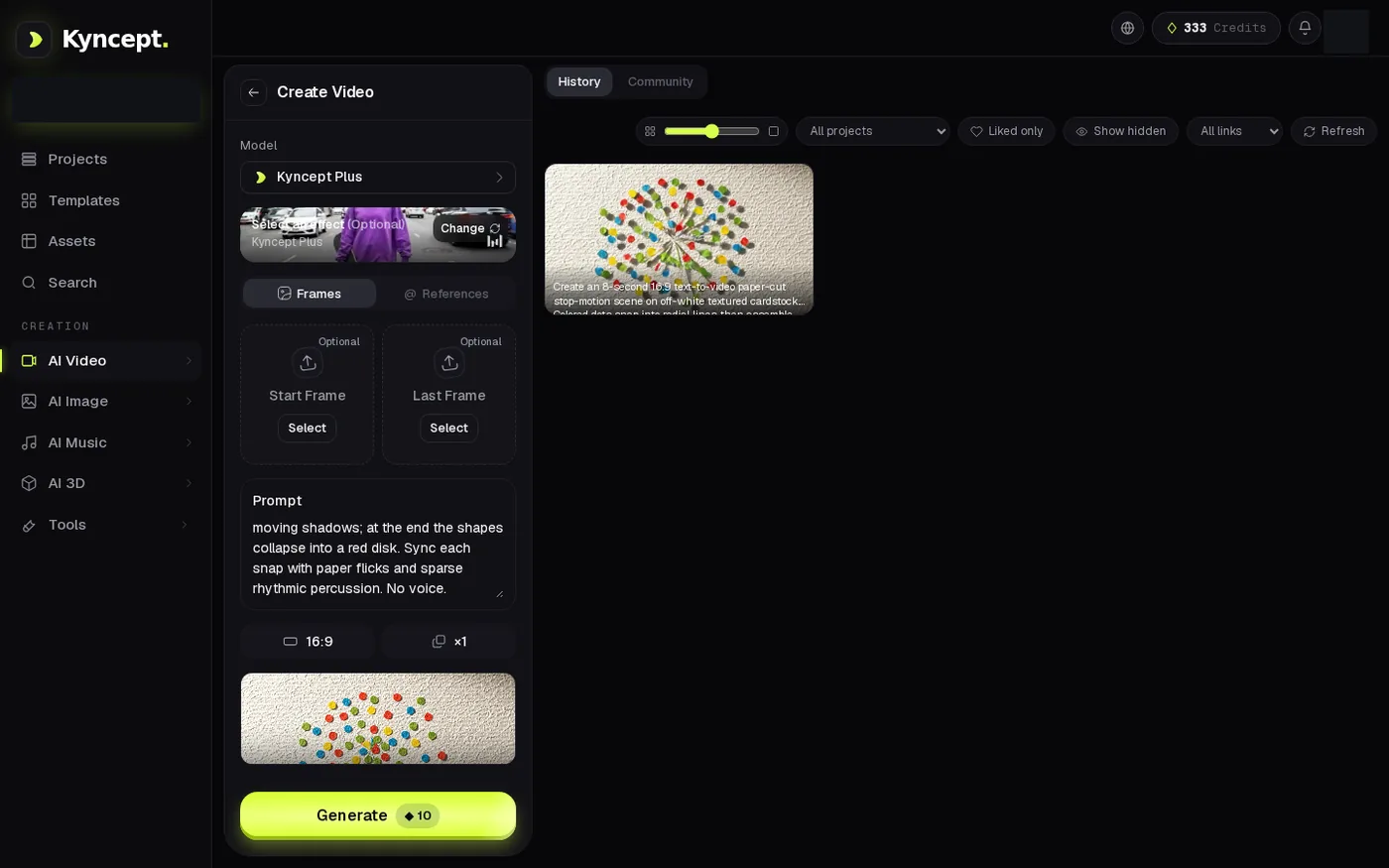
Kyncept's first completed Tokyo result. The remaining two jobs are separate successful charges, not extra cuts from this one job.
The allocation formula has an assumption in its denominator
A subscriber paying the displayed $59 for 1,200 Higgsfield credits has an internal list-price allocation of $59 ÷ 1,200 = about $0.04917 per Higgsfield credit, provided that the subscriber can use the entire bundle. Nine such units allocate $59 × 9 ÷ 1,200 = $0.4425 to the one observed Higgsfield video.
Independently, $59 for 1,200 Kyncept credits produces the same numerical internal allocation of about $0.04917 per Kyncept credit under the same full-use assumption. Ten Kyncept units allocate $59 × 10 ÷ 1,200 = $0.49167 to each observed eight-second video. The equal numerical unit rates happen to follow from these two particular public monthly plans. They do not mean a Higgsfield credit can buy a Kyncept generation, or that the resulting videos are interchangeable.
This is proportional accounting for an included bundle. If a subscriber makes only one video all month and pays solely for that subscription, the actual subscription outlay is still $59, not $0.44 or $0.49. If the subscriber also uses the credits for other tasks, the cash cost must be allocated across those tasks by a stated method. The trial itself used available balances and did not measure a $59 payment.
What changes at 30 jobs a month
A hypothetical month of 30 copies of the tested Higgsfield settings would use 30 × 9 = 270 Higgsfield credits. A hypothetical month of 30 copies of the tested Kyncept settings would use 30 × 10 = 300 Kyncept credits. Both totals fit within their respective 1,200-credit monthly bundles; 930 Higgsfield or 900 Kyncept credits would remain if nothing else were generated. Both subscribers still face the listed $59 monthly plan price in this deliberately narrow scenario, not a new charge of $13.28 versus $14.75 at month-end.
The proportional figures $59 × 270/1,200 = $13.275 and $59 × 300/1,200 = $14.75 describe only shares of prepaid bundle capacity. They are useful for internal planning if other work consumes the remaining capacity; they are misleading as statements of actual bills. Equally important, 30 short Higgsfield selections would not supply the same total seconds as 30 eight-second Kyncept files, and this case has not tested 30 successful submissions on either service.
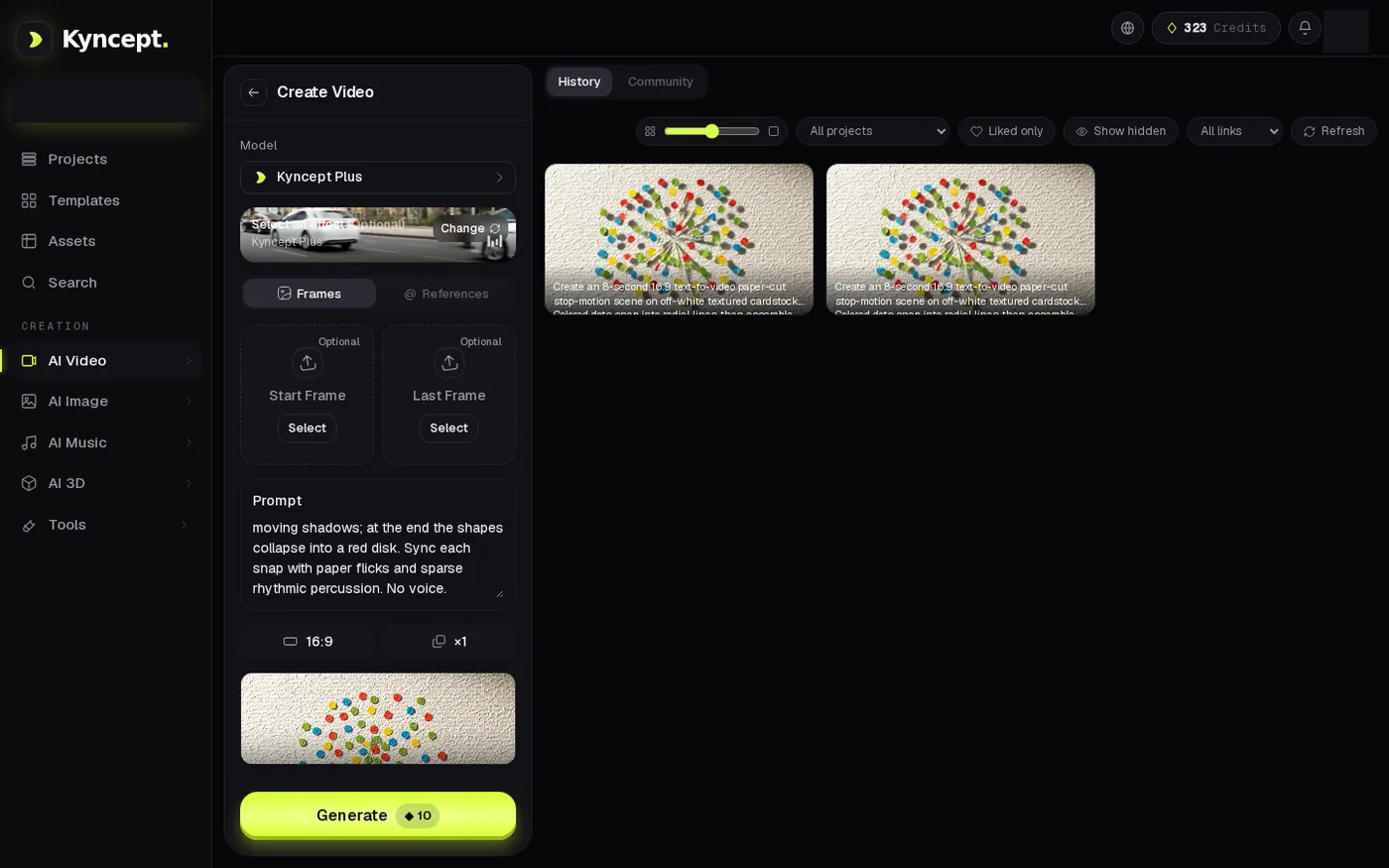
Another completed Kyncept job, not evidence that a 30-job month was actually run.
A fully used bundle is a ceiling on count, not on creativity
Under the narrow assumption that every included credit can go to the exact tested job with no additional charges, 1,200 ÷ 9 funds at most 133 complete Higgsfield five-second jobs, leaving three credits. 1,200 ÷ 10 funds 120 complete Kyncept eight-second jobs, leaving none. Those numbers are capacity arithmetic, not measured production volumes, not identical runtime delivered, and not a promise that either product will always offer the same settings at the same debit.
The observed Kyncept pairwise video SSIM values—0.988805, 0.988757 and 0.988794—are a reason to distinguish completed jobs from distinct usable edits. They describe three runs of one prompt, not the diversity of 120 different prompts. Higgsfield's one completed Tokyo file cannot be scored on repeat diversity at all. Any “120 versus 133 useful videos” claim would overstate both sides of this exercise.

The first Kyncept sequence supplies the visual basis for the repeatability caveat in the capacity math.

The second sampler is close to the first; the full files are different, but both count as completed jobs.
Images are a clearer same-model allocation example—with limits
The same Tokyo study also generated two Nano Banana Pro images per product, with the displayed model name and prompt aligned. Higgsfield debited two of its credits per PNG, with balances 6→4→2. Kyncept debited one of its credits per JPEG, 313→312→311. At the two selected $59/1,200 bundles, the hypothetical full-use allocation is about $0.09833 per Higgsfield image and $0.04917 per Kyncept image. This is an illustration of each plan's own rate times each platform's own observed debit, not a cross-platform credit exchange.
The four originals each measure 1376×768, and this tester's visual assessment of this small sample is that content quality is broadly a tie. It is not a blind perceptual study. Higgsfield's two originals have a visible baked-in brand watermark; neither of the two inspected Kyncept originals showed one. But Higgsfield wrote PNG and Kyncept JPEG: a smaller compressed file is not automatic evidence of a better or worse picture. Eligibility for watermark-free export on other plans was not tested.

The first Higgsfield Tokyo image viewed in its result context; its archived raw PNG retains the visible brand mark.
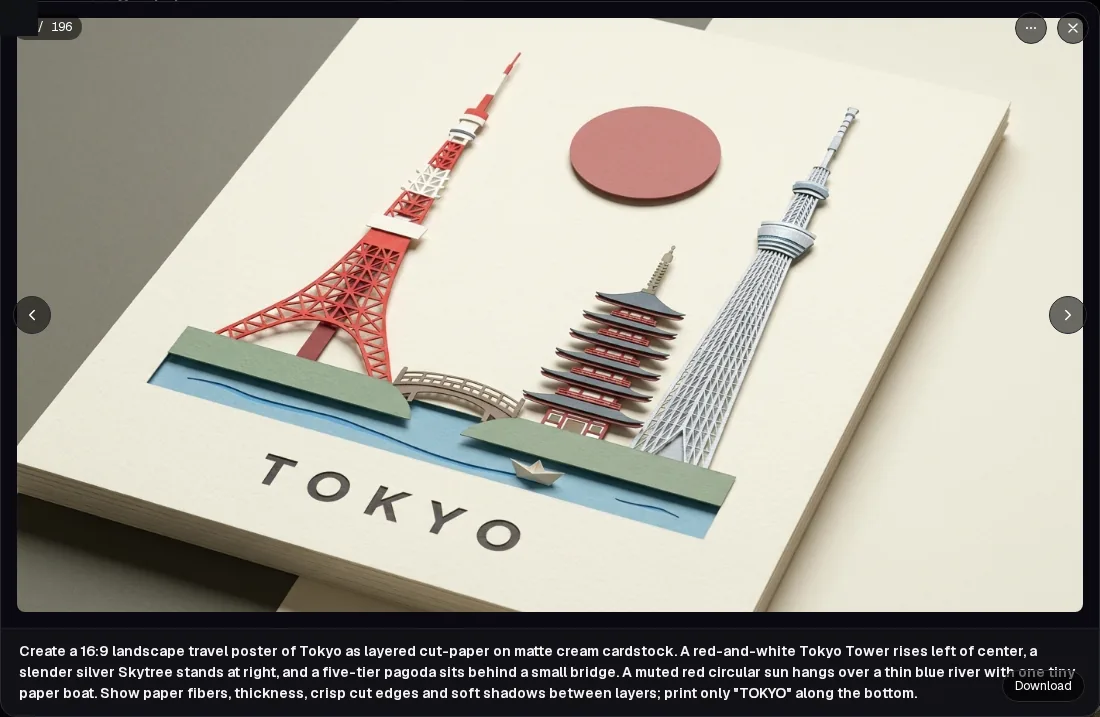
The first Kyncept Tokyo image viewed in its result context; the archived raw JPEG was checked separately.
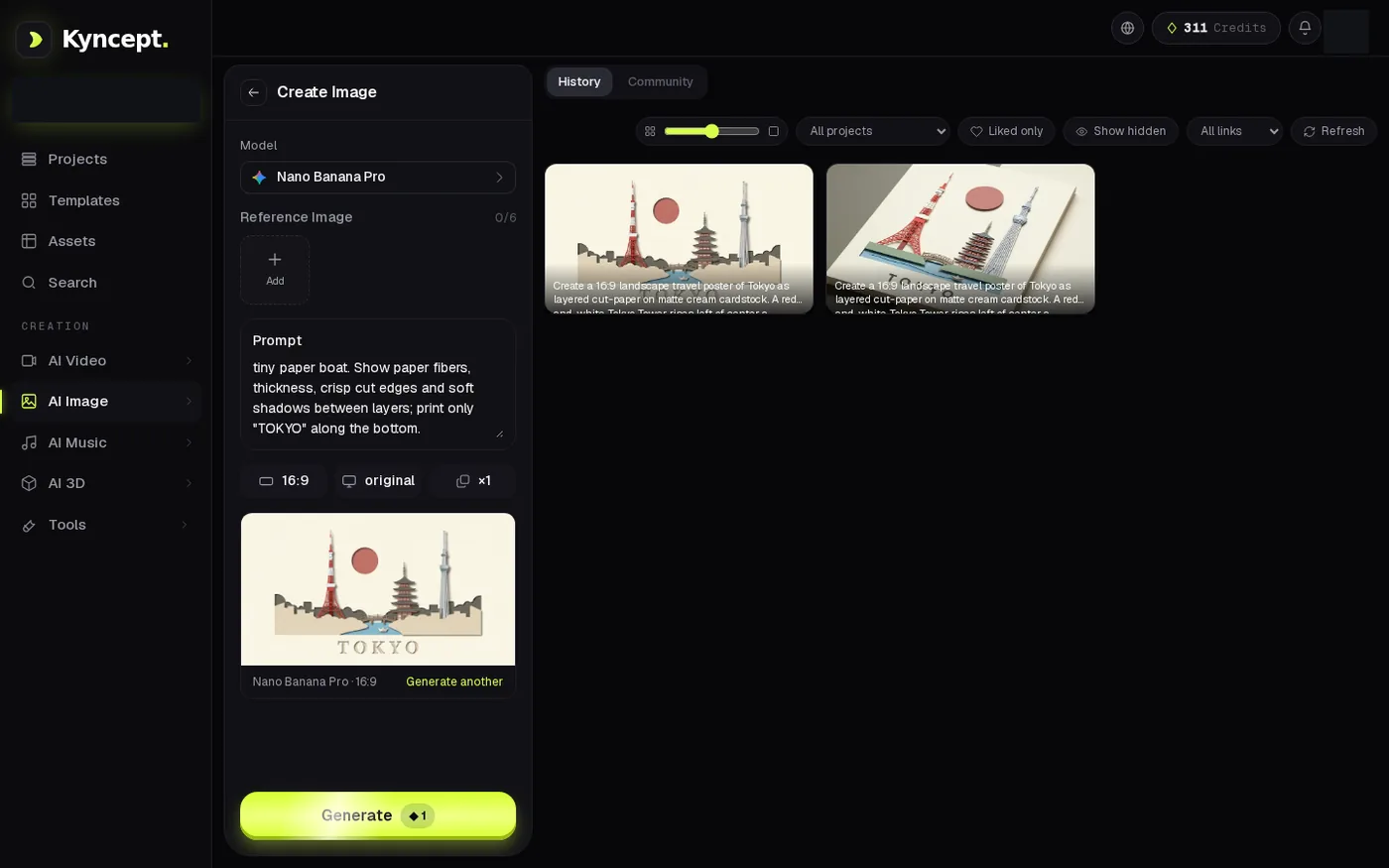
The second Kyncept Tokyo image also completed; the two images are separate one-credit jobs.
Why output seconds and usable variants remain outside the price tag
One Higgsfield video delivered 5.042 seconds; each Kyncept video delivered 8.000 seconds. The Higgsfield file has 1904×1104 source pixels despite its 720p UI selection; Kyncept's are 1280×720. More pixels and more seconds measure different axes, and neither captures scene quality, editability, successful execution under other prompts, or the cost of redoing a near-repeat. This is why choosing the smaller of $0.4425 and $0.4917 as a “winner” would be a category error.
There are additional unknowns: plan entitlements can change; promotional unlimited periods and account-specific offers can alter effective usage; local taxes and currency conversion are absent; and a user may leave credits unused. Public pages disclose some features, but this trial did not purchase a plan to validate invoice totals or commercial rights. For this case the auditable conclusion is the method and its conditions, not an unqualified price-performance crown.
Final verdict: the allocation is useful only when labeled
At the observed public monthly bundle prices, the single tested Higgsfield job allocates $0.4425 and the tested Kyncept job about $0.4917 if the separate 1,200-credit bundles are fully used. That is an honest budgeting line, not a receipt and not a comparison of equal-length, equal-resolution or equally varied outputs. A different billing cycle, model choice, unused balance or publication date can change the calculation. The first price sentence in any reuse of these figures should include the assumption, not put it in a footnote.
Which one I would use for this job
I would use the case evidence to select the output I actually need, then recalculate against the current plan in my own account. For a longer eight-second Tokyo take, Kyncept's current site shows the Pro context; for a five-second Higgsfield take, its public Plus card is the price basis here. Neither product was proven universally less expensive per usable edit. Recheck the pricing page immediately before paying; no payment was made for this analysis.
Originally published on Medium: Higgsfield Pricing Review 2026: The $59 Credit Allocation Trap.